Common Technical Mistakes in Before-and-After Photography
From Eminence: The New Standard of Plastic Surgery MarketingThe quality of a surgeon's work is partly judged by how it is presented.
Poor Photography Quality Costs Patients
Even though before-and-after photography is one of the most powerful assets a plastic surgeon has for communicating the quality of their work, a large audit of Instagram before-and-after photography found that approximately 40 percent of posts scored in a low-quality range on standardized quality criteria. Lighting, zoom, and timing were among the most frequently neglected elements.
The quality of a surgeon's work and the quality of its presentation should reflect one another; otherwise, patients may underestimate the value of the results. Despite the current popularity of video content, prioritizing result photography remains a priority. A recent survey on plastic surgery social media found that photo posts were preferred over video posts, and that before-and-after results were the most influential factor in plastic surgeon selection via social media. Patients are likely to value static before-and-after photographs over video because they allow direct visual comparison when evaluating surgical outcomes.
Technical Promblems That Undermine Credibility
The same failures appear repeatedly across before-and-after galleries. The good news is that most are preventable without a professional photographer. Marked floor positions for patient placement, a fixed lighting setup, and a written posing guide allow the surgeons or any staff member to produce high-quality images.
Investing in adequate camera equipment provides a strong foundation; low resolution and blurriness can make results appear less precise than they are. Regular lens cleaning, correct camera settings, and test shots before each session help control most quality-related issues. Lighting conditions are equally consequential. Natural window light varies by time of day, weather, and season. A fixed lighting setup, positioned identically for both the before and after photographs, is the most reliable way to control this variable.
Varying camera angles and patient positioning create inconsistencies between the before and after shots. Variations in head position between preoperative and postoperative photographs can create apparent changes that are unrelated to the procedure itself. Posture and facial expression should be reproduced as consistently as possible. When a patient is photographed with a neutral expression before surgery and smiling afterward, the perceived improvement may exceed the actual surgical result. Following written protocols can reduce these inconsistencies.
The background of the images should remain as neutral as possible so that the attention remains on the patient. Furthermore, neutral colors help maintain a natural skin tone, and match the result photography to the practice's brand color palette. Photo editing should be limited to technical corrections, such as exposure correction, without altering the scars or the surgical result.
The impact of a lens’s focal length is rarely discussed, even though it can significantly alter how the result appears in photos and affect the apparent shape of the face. When a camera is positioned close to the patient’s face, facial proportions become distorted: the nose appears larger and more projected, the chin appears smaller, and the midface appears wider. This is why the shooting distance needs to remain consistent. A difference in the shooting distances can distort facial proportions and make the surgical result appear distorted.
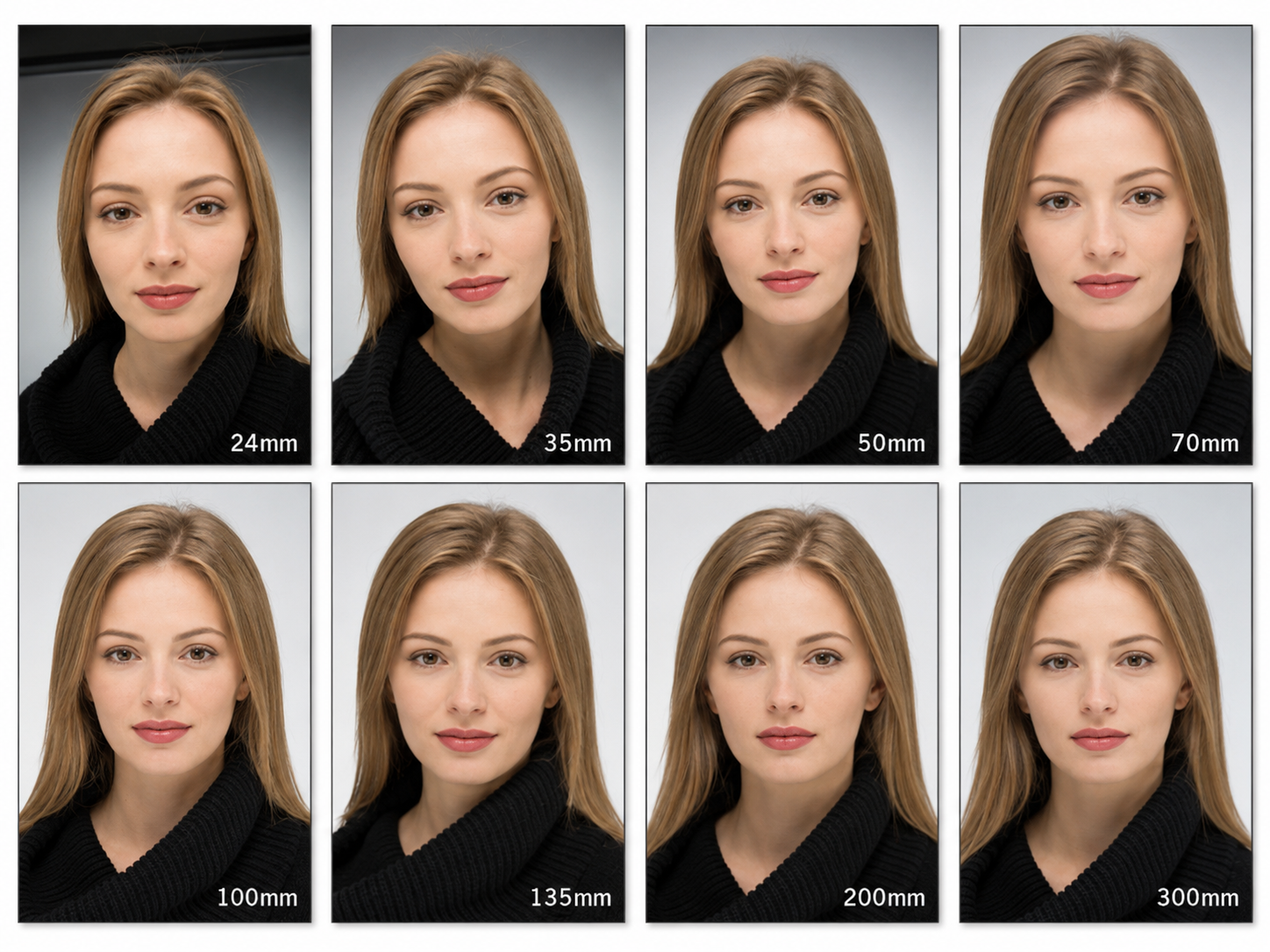
A photography protocol ensures consistency of before-and-after photographs. Eight photographs of the same person, taken during the same session, show how dramatically camera setup can change facial appearance. As the camera moves from a very close, wide view to a more distant, narrower one, the face appears progressively more natural and proportionate. The subject’s nose, jawline, and overall facial balance shift noticeably across the images despite no physical change in the person being photographed.
Patients are typically looking for a case that resembles their own starting anatomy, a reference point for projecting what their own result might look like. A before-and-after gallery dominated by a single patient demographic can make the practice appear specialized in a narrow range of anatomy. A gallery that includes both subtle refinements and more dramatic transformations, where applicable, helps patients understand whether the practice’s aesthetic range aligns with their own goals. Patients researching a procedure may compare several surgeons simultaneously, viewing their results side by side across websites and social media. This means that the quality and consistency of photography can strongly influence how a practice is perceived relative to competitors. Practices that invest in high-quality result photography can still stand out in a field where inconsistent presentation remains common.
Before-and-after photography entails implications far beyond marketing, involving patient privacy and professional responsibility. Displaying photographs without explicit written authorization can expose a practice to considerable legal and reputational risk. For this reason, explicit written consent should be obtained and documented at the time photographs are taken, with clear records of how images may be used across websites, social media, advertising, and educational materials.
Transparency in Result Presentation
Before-and-after images are subject to several inherent limitations. Results may have been captured at a misleadingly favorable point in recovery or photographed from a particularly flattering angle.
Contextual information, such as captions indicating when post-operative images were taken, help patients adjust their expectations. Where applicable, providing further context helps patients understand which changes resulted from surgery and which characteristics remain unchanged. Practices that openly discuss limitations are likely to be perceived as honest and more trustworthy than providers relying on aggressively curated result galleries.
Video can serve as a valuable secondary format alongside static before-and-after photography by adding a sense of dimensionality that photographs alone cannot fully convey. A rhinoplasty patient slowly turning their head on camera allows viewers to observe the result from multiple perspectives rather than a single carefully selected angle. Used in this way, video can strengthen credibility when filmed under consistent, transparent conditions, by reducing the perception that outcomes depend primarily on pose, lighting, or angle selection.
About the Author
Jen Ahlsten is a brand strategist and author specializing in luxury branding and marketing for plastic surgeons. She is the founder of Vitruviani and wrote Eminence: The New Standard for Plastic Surgery Marketing.
She publishes educational content on how branding functions as a long-term commercial asset in plastic surgery. Her 2025 study, available on ResearchGate, compares how patients perceive branded and unbranded plastic surgery practices across five dimensions, including trust, intent to book, and willingness to pay a price premium. Ahlsten's background is in marketing and fine art.
Selected publications and resources: LinkedIn · Research · Book · Podcast · Substack· Email
Sources
Ahlsten, J. (2026). Eminence: The New Standard for Plastic Surgery Marketing. Vitruviani.
Aldahlawi, S., & Al-Noury, K. I. (2024). Picture perfect: Standardizing and safekeeping clinical photography in plastic surgery. Annals of Medicine and Surgery.
ElAbd, R., Alghanim, K., Alnesef, M., Alyouha, S., & Samargandi, O. A. (2023). Aesthetic surgery before-and-after photography bias on Instagram. Aesthetic Plastic Surgery.
Plastic Surgery Specialists. (2021). Photographic Standards in Plastic Surgery.
Shiah, E., Weidman, A. A., Valentine, L., Alvarez, A. H., Foppiani, J. A., & Lin, S. J. (2023). Capitalizing on social media: An evaluation of the public's preferences for plastic surgery social media content. Journal of Plastic, Reconstructive & Aesthetic Surgery.
Soares, D. J., et al. (2022). Introducing the SEPIA scoring system: A tool for the assessment of standardization and quality in aesthetic surgery before-and-after photographs. Plastic and Reconstructive Surgery – Global Open.
Ward, B., Ward, M., Friedman, O., & Paskhover, B. (2018). Nasal distortion in short-distance photographs: The selfie effect. JAMA Facial Plastic Surgery.