Tone as a Reflection of Brand Identity in Plastic Surgery Marketing
From Eminence: The New Standard of Plastic Surgery Marketing
Brand identity is expressed as much through language as through design.
Verbal Identity and Brand Expression
Language gives patients another way to understand a practice beyond its visual identity. Brand tone refers to how the practice's expertise and brand positioning come across in written communication. In order to appeal to the intended audience, It should reflect the characteristics the practice wants patients to associate with it.
Even without explicit guidelines, each practice develops its own communication tone. Website copy, Instagram captions, email responses, consultation forms, advertisements, review replies, and post-procedure materials all contribute to the patient’s experience of the plastic surgery brand.
Jennifer Aaker’s 1997 brand personality research showed that consumers attribute human-like traits to brands, including sincerity, excitement, competence, sophistication, and ruggedness. This means that the tone a practice uses influences what kind of qualities patients attribute to the practice, impacting their choice to contact the surgeon later.
The most effective language in plastic surgery tends to be specific and restrained. This may materialize as sharing educational content in a video format, or as a detailed captions providing further information about the result visible in a before-and-after comparison. Popular slogans and phrases, such as “natural-looking results” or “helping patients feel confident” may lose pursuasiveness because a patient comparing several surgeons is likely to encounter the same claims across several websites. “Natural-looking results” becomes a sensible claim when the practice explains the logic behind the decision-making.
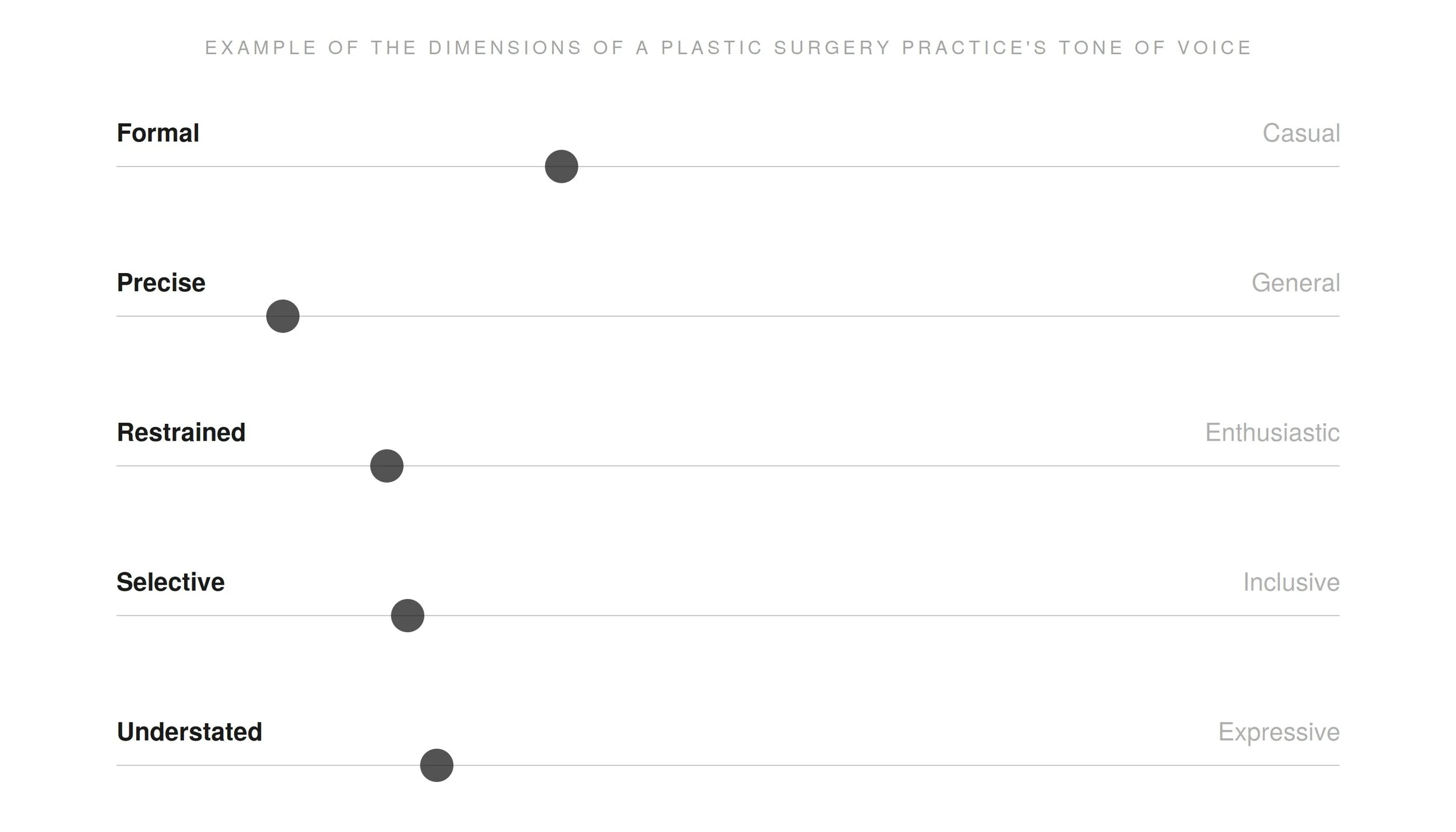
Rather than selecting a single characteristic, tone can be defined along multiple dimensions, allowing the practice to communicate complementary values simultaneously.
Language and Commercial Pressure
Decision-making in plastic surgery requires medical screening, financial planning, psychological readiness, and recovery time. Copywriting that pushes speed can make the practice feel misaligned with the nature of the service itself. Wording such as “limited-time offer,” “summer special,” “flash sale,” and “last chance” risks lowering perceived professionalism and seriousness. Is the practice carefully selecting patients, or is it simply filling a schedule? In some markets, such as the UK, advertising that pressures consumers to make a quick decision about cosmetic surgery can even breach advertising regulations.
Promoting discounts and financing options language can create produce similar kind of damage to the brand image, especially for practices seeking to appeal to premium clients. Leading with low prices may attract some clients, but often at the expense of the practice's reputation. The more aggressively a practice appears to sell, the more difficult it may become to maintain professionalism. Selective patients may seek reassurance that the surgeon will refuse unsuitable candidate or recommend more conservative approaches when necessary. Marketing that feels overly commercial can inadvertently create negative perceptions of the surgeon’s clinical judgment.
In fact, a 2020 experimental study in the Journal of Medical Internet Research found that health messages written in strongly positive, enthusiastic language were rated as less trustworthy and less credible. Participants judged the communicator as lower in integrity and benevolence. The study indicates that overly upbeat and promotional-sounding language in medical contexts may make people more skeptical.
Most practices benefit from choosing a tone that reinforces the importance of careful decision-making, providing insight into the surgeon’s approach, inviting the patient to request a consultation, and then understand their candidacy in relation to anatomy and expectations. Seemingly minor details contribute to how the practice comes across. “Schedule a consultation” sounds different from “claim your spot.” “Determine whether surgery is appropriate” sounds different from “start your transformation.” “Discuss your goals with the surgeon” sounds different from “get the body you have always wanted.”
On Cross-Platform Consistency
The way a practice communicates sets expectations for the patient experience. When the website feels thoughtful and personal but later communications feel generic or transactional, the experience can feel less considered than the brand initially suggested.
Perceived professionalism increases when the same written tone is maintained across patient-facing platforms. The goal is for the values of the practice to be reflected in its language, regardless of where patients encounter or interact with the practice. Context matters: captions ought to be briefer than blog posts, and in-person communication is likely to be warmer than email communication. Clear brand guidelines, followed by all staff members, help ensure that every piece of patient-facing communication conveys a consistent image of the practice.
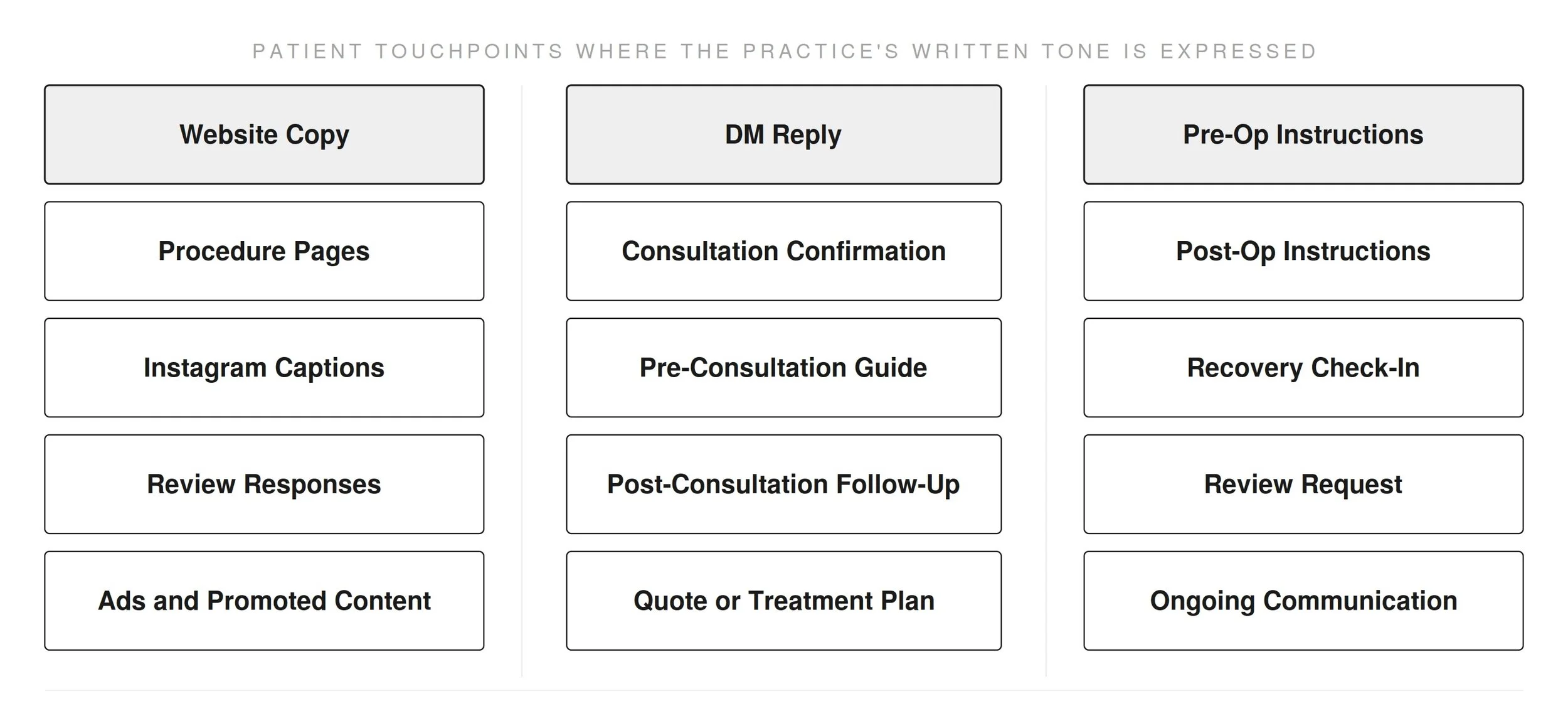
Every piece of written communication shapes how the patient perceives the practice. Cross-platform consistency means that the same underlying character of the practice remains recognizable across different contexts. A patient should be able to move from a website to a social media post without feeling that they are suddenly interacting with a different practice.
Tone of communication is ultimately part of a larger question about the practice's business objectives. Brand perception contributes to client acquisition and perceived value of services, making brand positioning an important business decision. Vitruviani’s brand consulting helps plastic surgery practices assess whether their current positioning supports their commercial goals.
About the Author
Jen Ahlsten is a brand strategist who specializes in luxury branding and marketing for plastic surgeons. She is the founder of Vitruviani and author of Eminence: The New Standard for Plastic Surgery Marketing.
She publishes educational content on how branding functions as a long-term commercial asset in plastic surgery. Her 2025 study, available on ResearchGate, compares how patients perceive branded and unbranded plastic surgery practices across five dimensions, including trust, intent to book, and willingness to pay a price premium. Ahlsten's background is in marketing and fine art.
Selected publications and resources: LinkedIn · Research · Book · Podcast · Substack· Email
Sources
Aaker, J. L. (1997). Dimensions of Brand Personality. Journal of Marketing Research, 34(3), 347–356. https://www.jstor.org/stable/3151897
Ahlsten, J. (2026). Eminence: The New Standard for Plastic Surgery Marketing. Vitruviani.
König, L., & Jucks, R. (2020). Effects of Positive Language and Profession on Trustworthiness and Credibility in Online Health Advice: Experimental Study. Journal of Medical Internet Research, 22(3), e16445. https://pubmed.ncbi.nlm.nih.gov/32154786/