The Patient's First Impression of Your Plastic Surgery Practice
From Eminence: The New Standard of Plastic Surgery MarketingA common first encounter with a plastic surgery practice is a mobile screen viewed briefly while the patient is doing something else.
Your Website Has 50 Milliseconds to Make a Good First Impression
For many prospective patients, the first impression of a clinic is digital. Surgeons increase their chances of converting visitors into patients by ensuring their online presence is technically and visually as strong as possible, conveying an accurate image of the clinical practice.
First impressions are fast because they are meant to be; people tend to register signs of legitimacy before they evaluate details. Visual cues impact perceived reliability. This applies to website design as much as it applies to a surgeon's personal grooming and the neatness of their consultation room; attention to detail is often interpreted as evidence of credibility and professionalism.
Visual environments shape perception before conscious thought. In 2006, researchers at Carleton University measured how quickly people form stable judgments about websites’ visual appeal. The answer was 50 milliseconds, a fraction of the time of a single blink. This directly contradicts a basic assumption most of us hold about how we think. Rather than evaluating information independently of its context, people often register the context as a feeling first.
Ease as a Credibility Cue
First impressions shape the way later information is interpreted. A patient who lands on a clean and modern website with strong photography will evaluate the surgeon's background with a degree of unconscious trust already in place. By contrast, a patient who lands on a slowly downloading website with blurry images, will read the same content already experiencing mild skepticism.
Studies in cognitive psychology conclude that information that is easy to process tends to be perceived as more credible than information that requires effort to interpret or understand.
In everyday life, we can observe this by paying attention to how the way information is presented affects its appeal. When an idea is explained clearly and simply, the speaker comes across as more competent. If the same idea is explained in a vague or an overly complex way, skepticism about the speaker’s credibility is more likely to arise.
Because of this function, visually ordered and easily legible digital materials can make information appear higher quality. When a surgeon's website is fast, clear, and easy to navigate, that cognitive ease can improve how patients perceive the practice.
By contrast, friction caused by the way information is presented creates cognitive resistance that is then attributed to the quality of the practice. Research on user experience shows that visually complex websites tend to be judged less favorably than simpler designs, even before users have had time to evaluate the content in depth. The illustration below demonstrates this in a visual format.
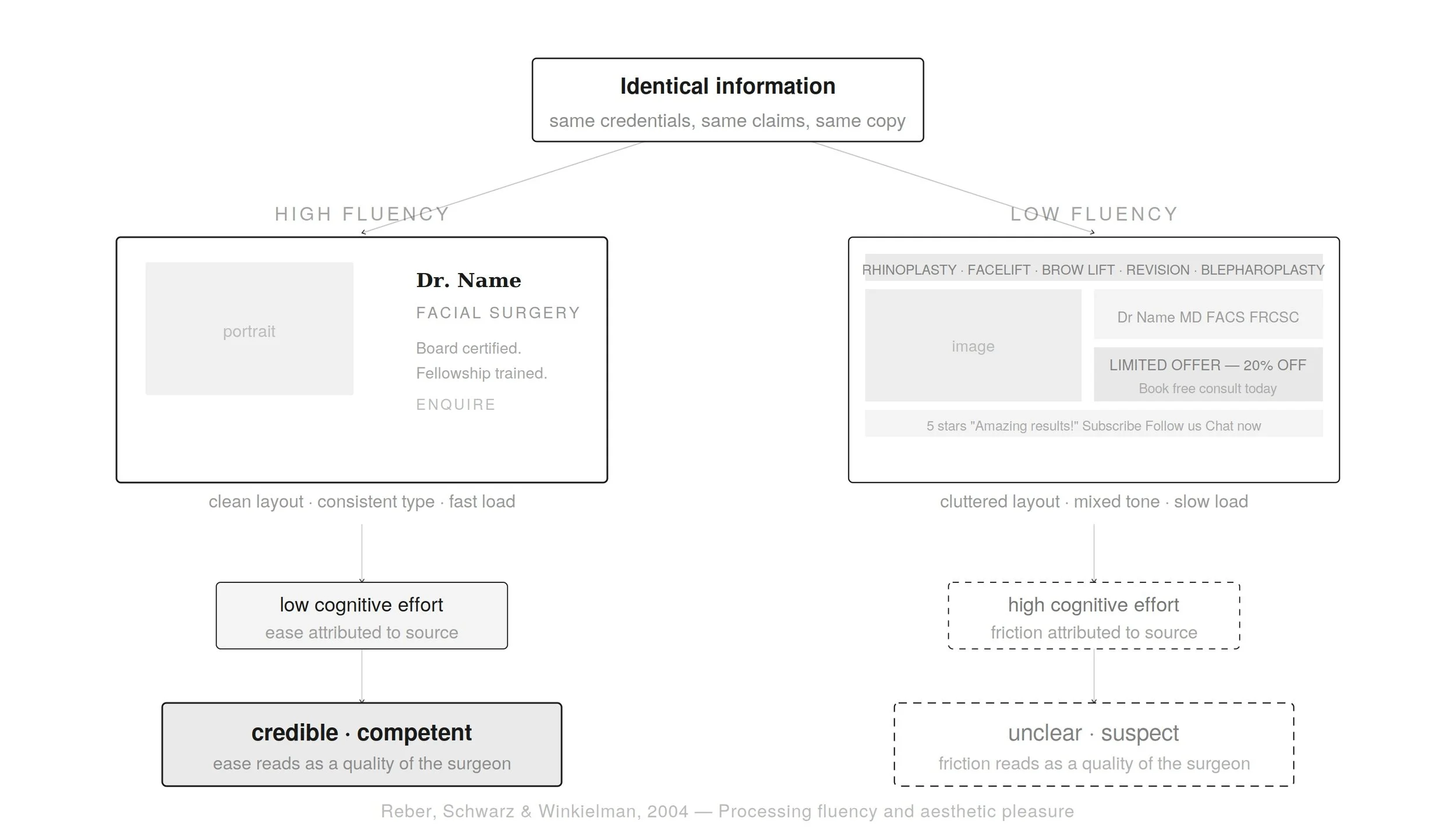
Is beauty in the perceiver's processing experience? When a website loads quickly, its layout is legible, and its visual hierarchy requires no effort to navigate, the brain registers that ease as a quality of the practice rather than a quality of the design. The same credentials and the same clinical claims, presented in a visually complex or effortful environment, may be evaluated as less credible.
The Halo Effect in Medical Judgment
Once formed, the first impression begins to migrate into adjacent assessments without the patient's awareness, altering how new information is processed before it reaches conscious evaluation. In 1920, American psychologist Edward Thorndike showed that evaluators' ratings of one trait tended to spill into ratings of other traits. In his study, commanding officers were asked to rate soldiers on separate qualities such as physique, intelligence, leadership, and character. Soldiers who were rated highly in one domain were often rated highly across unrelated domains, suggesting that an overall impression can distort supposedly separate judgments. The officers attempted to assess each quality independently, but the effect occurred anyway, without conscious awareness. Thorndike concluded that a single overall impression shapes judgments of separate attributes by default.
Research later showed that a favorable overall impression, defined by appearance or presentation, leads to higher judgments of intelligence and competence. The same mechanism can plausibly affect medical judgment, and therefore, each patient-facing element can contribute to the impression of competence. A practice with a modern and up-to-date online presence is often perceived as more competent for the same reason that a clinic with attentive staff is perceived as more competent. Digital details such as a simple digital booking process, third-party profiles kept up to date, and result photography taken in crisp light, shape the patient's sense of the professionalism of the practice.
Patients Judge Books by Their Covers
User Experience (UX) research suggests overall visual quality often shapes whether users continue into the page at all, and that people register overall visual structure and tone before engaging deeply with detailed content. Primary photography signals quality or its absence before the patient reads a word, and a headline that defines the surgeon's position registers in the same instant. The surgeon's introduction, credentials, before-and-after imagery, and procedure descriptions get reviewed only if the first impression manages to hold attention past the first few seconds. Since the first encounter is likely to take place on a mobile device, mobile optimization is therefore a high-priority adjustment.
Consider two surgeons whose rhinoplasty results are clinically comparable, with similar academic credentials and work experience. The main difference between their practices is the quality of their digital marketing.
The first surgeon's website was designed a year ago; a visually restrained design including generous spacing between elements, a neutral color palette, and professionally shot photography. The surgeon’s social media posts repeat the color palette and fonts used on the website. A prospective patient gets an immediate feeling that the practice is modern and serious.
The second surgeon's clinical results are equally good, but their website is difficult to read on mobile, and includes several stock photographs. This surgeon’s social media is not curated to match any other marketing materials, and the tone shifts noticeably from post to post. The prospective patient does not experience the same sense of credibility, and submits an inquiry to the first surgeon.
This can be partly explained by a pattern known as negativity bias. Negative cues and events often carry disproportionate influence, because the human mind does not weigh positive and negative information equally. Some accounts explain negativity bias partly through adaptive threat-detection logic, observable across many areas of judgment and behavior. As a result, positive experiences build credibility and trust gradually, while one negative experience can interrupt that process. The graph below illustrates how inconsistency across patient-facing materials can contribute to hesitation during the decision-making process.
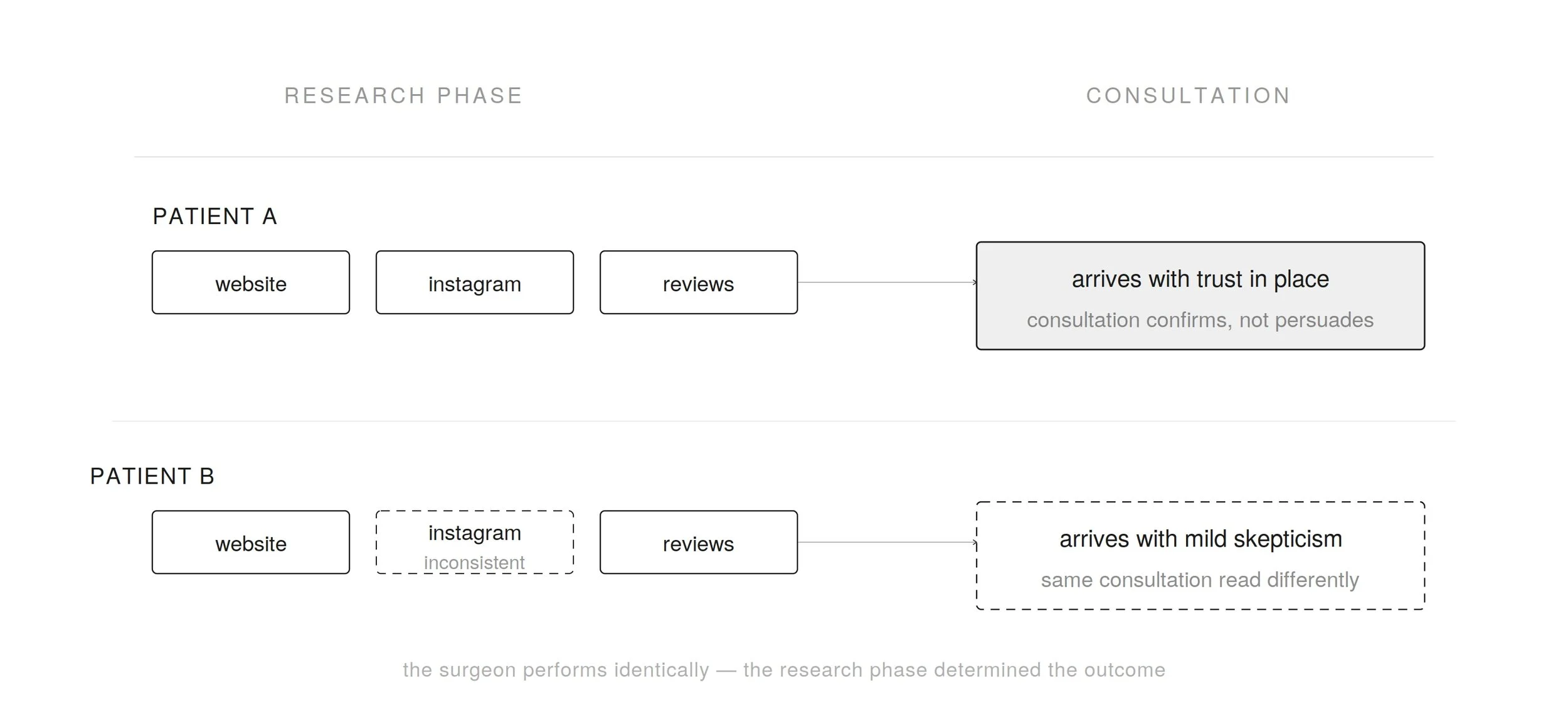
A private consultation is rarely the first trust-building moment between a patient and a provider. A coherent digital experience brings in a patient already leaning toward trust. An inconsistent one forces the surgeon to overcome doubts that the patient might not even be conscious of.
About the Author
Jen Ahlsten is a brand strategist and author specializing in luxury branding and marketing for plastic surgeons. She is the founder of Vitruviani and wrote Eminence: The New Standard for Plastic Surgery Marketing.
She publishes educational content on how branding functions as a long-term commercial asset in plastic surgery. Her 2025 study, available on ResearchGate, compares how patients perceive branded and unbranded plastic surgery practices across five dimensions, including trust, intent to book, and willingness to pay a price premium. Ahlsten's background is in marketing and fine art.
Selected publications and resources: LinkedIn · Research · Book · Podcast · Substack· Email
Sources
Ahlsten, J. (2026). Eminence: The New Standard for Plastic Surgery Marketing. Vitruviani.
Dion, K., Berscheid, E., & Walster, E. (1972). What is beautiful is good. Journal of Personality and Social Psychology.
Nielsen Norman Group. (2021). First impressions matter: How designers can support human automaticity.
Rozin, P., & Royzman, E. B. (2001). Negativity bias, negativity dominance, and contagion. Personality and Social Psychology Review.
Thorndike, E. L. (1920). A constant error in psychological ratings. Journal of Applied Psychology.